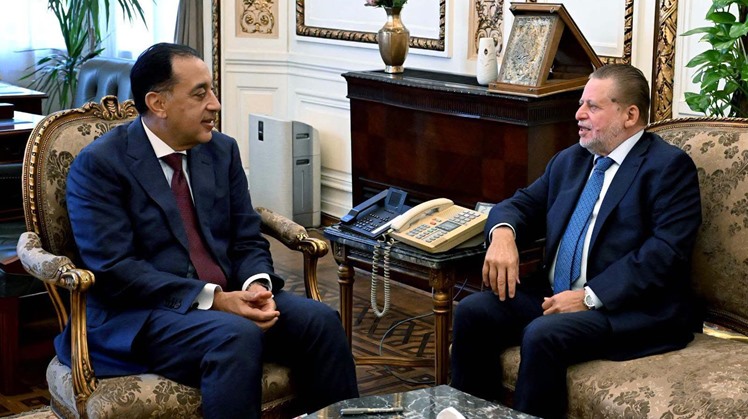
Egyptian Prime Minister Mostafa Madbouly met with Central Bank Governor Hassan Abdalla to review priority economic issues and discuss measures to strengthen financial and monetary stability.
The meeting covered preparations for a national economic transformation program being developed jointly by the government and the Central Bank of Egypt, as well as the performance of the national economy and ongoing efforts to further reduce inflation and increase foreign currency inflows.
The two sides also stressed the importance of maintaining safe levels of foreign exchange reserves capable of covering the country’s strategic needs for essential commodities. They also reviewed efforts to strengthen strategic reserves through continued coordination between the government and the central bank.
Abdalla briefed the prime minister on his participation in the 48th annual meetings of the Association of African Central Banks, hosted by the Central Bank of Kenya in Nairobi from September 13 to 18.
The meetings brought together governors from 34 central banks out of the association’s 41 member institutions, representing 53 African countries.
Abdalla also participated in the 14th meeting of the Board of Governors of central banks participating in the Pan-African Payment and Settlement System, held in Nairobi on the sidelines of the annual meetings.
He said Egypt’s participation reflected its efforts to strengthen banking relations at the regional level and expand economic and trade cooperation with African countries.
The Central Bank governor also discussed his participation in a high-level conference on the use of artificial intelligence in central banking, organized by the Central Bank of Kenya to mark its 60th anniversary.
According to Abdalla, discussions at the conference focused on three main areas: the use of AI in monetary policy and financial stability, the development of banking supervision and financial integrity, and AI governance and related risk management.
The conference also examined the potential use of AI to analyze large and diverse datasets and support economic forecasting.
 Sun, Sep. 20, 2026