Egypt - National Resilience
President Abdel Fattah El-Sisi on Tuesday called for stronger coordination among Egypt’s state institutions, more efficient use of national resources and greater public awareness as the country continues to navigate economic pressures, regional conflicts and evolving security challenges.
.png "160968-اجتماع-الرئبس-السيسي-مع-عدد-من-المسئولين-في-الحكومة-والمشايخ-والقوات-المسلحة-والشرطة-والمحافظين-(5)")
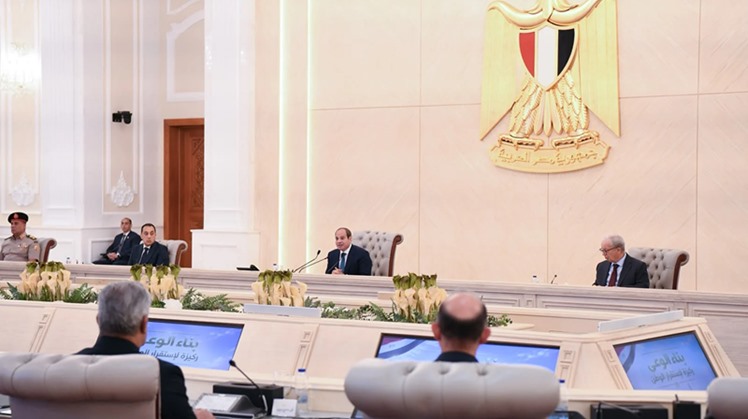
President Abdel Fattah El-Sisi during an expanded meeting at the Strategic Command headquarters in the New Administrative Capital.
Key Highlights
State coordination: El-Sisi calls for closer cooperation among institutions and local communities
Public awareness: President describes awareness as a key line of defense for the state
Economic pressure: Regional instability continues to weigh on Egypt’s economy and revenues
Regional policy: Egypt reiterates support for diplomacy, de-escalation and the two-state solution
Water security: Cairo maintains diplomacy as its preferred approach while protecting national interests
Public services: Government instructed to improve service quality and citizen interactions
Economic Pressure in Numbers
≈ $20 BILLION
Suez Canal revenues Egypt says it lost in recent years amid regional instability
≈ 4,500 VILLAGES
Representing approximately half of Egypt’s population, according to El-Sisi
A Broader National Discussion
El-Sisi made the remarks during an expanded meeting at the Strategic Command headquarters in the New Administrative Capital, attended by Prime Minister Mostafa Madbouly, the full Cabinet and governors, senior state officials, Armed Forces and police commanders, village mayors and community leaders, as well as experts and specialists.
The meeting brought together representatives of the state’s executive institutions and local communities to discuss domestic and regional challenges. The President stressed the importance of continuously bringing together state officials and community representatives to exchange views, particularly as Egypt faces multiple challenges requiring coordinated national action.
Awareness as a Line of Defense
El-Sisi said public awareness represents a key line of defense for Egypt, stressing the need to protect national capabilities and strengthen public confidence in state institutions.
El-Sisi called for the effective use of state resources, stronger public confidence in state institutions and continued efforts to safeguard the country’s internal cohesion.
He said attempts to undermine states can take different forms, including through social media, and urged institutions to continuously develop their tools to counter misinformation and protect public confidence.
The President also emphasized that preserving Egypt’s stability is a collective responsibility requiring cooperation between state institutions and citizens.
.png "163868-اجتماع-الرئبس-السيسي-مع-عدد-من-المسئولين-في-الحكومة-والمشايخ-والقوات-المسلحة-والشرطة-والمحافظين-(4)")
Officials and community representatives attend the expanded meeting at the Strategic Command headquarters.
The President linked part of Egypt’s economic challenges to the disruption experienced between 2011 and 2013, saying the resulting contraction had created consequences that could take as long as 15 years to overcome.
He also pointed to a series of external shocks since 2020, including the COVID-19 pandemic, the Russia-Ukraine war and the war in Gaza, which have placed additional pressure on the Egyptian economy.
El-Sisi said Egypt had lost around $20 billion in Suez Canal revenues in recent years as a result of regional instability.
On foreign policy, El-Sisi reiterated Egypt’s commitment to peace and said Cairo has no hidden agenda in the region.
He described the Palestinian cause as the central issue in the Middle East and argued that the continued failure to resolve it remains a major source of regional instability. He maintained that the two-state solution represents the only path toward achieving lasting peace and stability in the region.
El-Sisi also reaffirmed Egypt’s support for the security and stability of the Arab Gulf states and stressed the importance of maintaining freedom of navigation through international waterways in accordance with international law.
.png "168263-اجتماع-الرئبس-السيسي-مع-عدد-من-المسئولين-في-الحكومة-والمشايخ-والقوات-المسلحة-والشرطة-والمحافظين-(2)")
President El-Sisi addresses participants during the expanded meeting in the New Administrative Capital.
The meeting also touched on water security and Ethiopia’s dams, with El-Sisi stressing that Egypt continues to give diplomacy and peaceful solutions priority in addressing the issue.
At the same time, he emphasized that Egypt’s commitment to diplomatic efforts would not come at the expense of the country’s existence or the interests of its people.
Egypt, he added, is simultaneously working to expand its water resources through seawater desalination, wastewater treatment and water recycling.
Services and Local Communities
The meeting included presentations by ministers responsible for transport, health, local development, interior, electricity, finance, education, housing and higher education.
• Improve the quality of public services and government interactions with citizens
• Reduce costs associated with vehicle licensing
• Strengthen educational quality as part of broader reform efforts
• Connect national policies more closely with villages and local communities
El-Sisi said he was keen to hear directly from village leaders because Egypt has around 4,500 villages, representing approximately half of the country’s population.
.png "171708-اجتماع-الرئبس-السيسي-مع-عدد-من-المسئولين-في-الحكومة-والمشايخ-والقوات-المسلحة-والشرطة-والمحافظين-(6)")
Participants during the expanded meeting bringing together state officials and representatives of local communities.
AI and Strategic Security
During a luncheon with students of the Egyptian Military Academy, El-Sisi also held an interactive discussion covering water security, Ethiopian dams, artificial intelligence and developments across the Middle East, including the Strait of Hormuz and Bab el-Mandeb.
On artificial intelligence, the President stressed the importance of improving education to prepare future generations for rapid technological change. He called for greater attention to the potential benefits of AI while also preparing for its potential negative effects.
On regional developments, El-Sisi said the current instability had contributed to higher oil and basic commodity prices, with direct consequences for prices in Egypt. He reiterated that Egypt was working to reduce regional escalation and prevent a return to renewed fighting.
Scenes from the expanded meeting at the Strategic Command headquarters in the New Administrative Capital.
A Broader Approach to National Resilience
The meeting brought together economic, social, security, foreign policy and development issues within a single national discussion, underscoring the emphasis placed on coordination between Egypt’s political, administrative, security and local institutions.
Against the backdrop of continuing regional instability, economic pressures and strategic challenges ranging from water security to energy and maritime navigation, El-Sisi’s message centered on institutional coordination, efficient use of national resources and maintaining social cohesion.
 Tue, Sep. 29, 2026


.png "183438-اجتماع-الرئبس-السيسي-مع-عدد-من-المسئولين-في-الحكومة-والمشايخ-والقوات-المسلحة-والشرطة-والمحافظين-(3)")
.png "273577-اجتماع-الرئبس-السيسي-مع-عدد-من-المسئولين-في-الحكومة-والمشايخ-والقوات-المسلحة-والشرطة-والمحافظين-(1)")