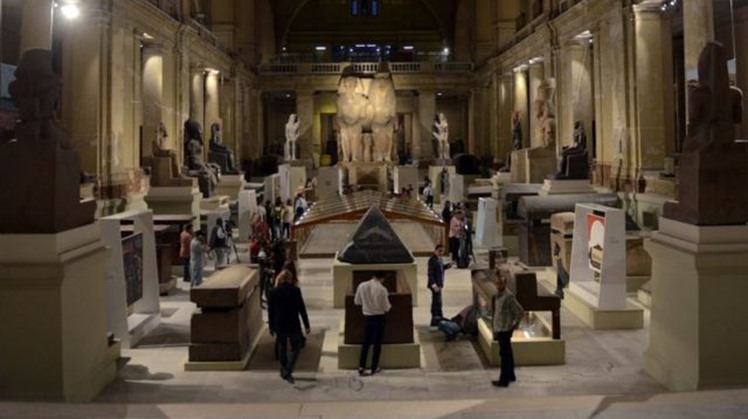
The development was recently carried out in room No. 2 in the Egyptian Museum in Tahrir, in which the mask of Tutankhamun and a number of his belongings were displayed, before it was transferred to the adjacent room No. 3 in preparation for its final transfer to the Grand Egyptian Museum, where the king’s possessions will be displayed for the first time. Once completely, and in turn, we contacted the archaeologist Sabah Abdel Razek, director general of the Egyptian Museum in Tahrir, to follow up on the development work of Hall 2, in which Tanis' collections will be placed, which will be displayed instead of the Golden King's collections.
Sabah Abdel Razek said, in exclusive statements to "The Seventh Day", that the development work of Hall No. 2 has been completed, and a new presentation scenario for the Tanis group has been implemented, but lighting work is currently underway in the hall in preparation for opening it to visitors.
The Director-General of the Egyptian Museum in Tahrir added that the museum display scenario for the museum's development stages has been completely completed in 22 halls, and the implementation of the new museum display scenario will start in the rest of the halls during the coming period.
Sabah Abdel Razek explained that we are currently completing the lighting work in the first 22 halls, provided that a new presentation scenario will be started in the rest of the halls, as the total halls are 100 halls, 22 have been completed and 78 halls remain.
Tanis’s holdings contain a large number of distinguished artifacts, amounting to 2000 pieces, in addition to the golden mask, and there is also the golden Sashing mask, which is from the same 22nd Dynasty, and there is another set of silver coffins, which is a very rare group.
The Tanis collection contains a large group of rare gold coins, not repeated in the Egyptian civilization, including necklaces, bracelets, accessories and many ornaments, and its holdings are called Tanis gold, because of its distinct and unrepetitive values.
The Egyptian Museum in Tahrir, in the heart of Cairo, includes the largest collection of ancient Egypt's antiquities, as it contains more than 136,000 Pharaonic antiquities, in addition to hundreds of thousands of antiquities in its stores.
As for its holdings, the Egyptian Museum consists of two floors, the ground of which is devoted to heavy artifacts, “such as stone coffins, statues, paintings, and wall inscriptions.” The upper floor is devoted to light antiquities, such as “manuscripts, statues of gods, royal mummies, relics of daily life, images of mummies, incomplete sculptures, statues and utensils of the Greco-Roman era, and antiquities.” especially the beliefs of the afterlife”, as well as complete collections such as the “Tutankhamun Collection”, and the museum also includes a huge number of Egyptian antiquities from prehistoric times until the end of the Pharaonic era, in addition to some Greek and Roman antiquities, including “a group of pottery (from the ages of Prehistoric), Narmer Pillar (Monotheism era), Khasekhem statue (dynasty 2), statue of Djoser (dynasty 3), statues of Khufu, Khafre and Menkaure (dynasty 4), statue of Ka'ber and statues of servants (dynasty 5), and the statue of the dwarf Sanab (dynasty) 6), the statue of Mentuhotep Nebhepetre (dynasty 11), the statues of Amenemhat I, II and III (dynasty 12), the Ka statue of King Hor (dynasty 13), the statues of Hatshepsut and Tuthmosis III (dynasty 18), the Tutankhamun group (dynasty 18), and K . group Noz Tanis, and a large group of mummies from different eras.
 Sun, Jul. 3, 2022