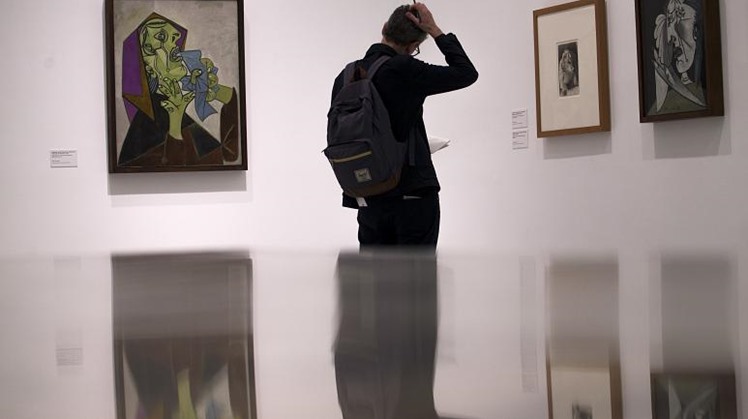
An exhibition organized by the Institut du Monde Arabe in the city of Turquin in northern France discusses the extensive imprint that Pablo Picasso left on the Arab world and the extent to which he influenced his work, even though he never set foot on his land.
According to newsfounded Mario Choueiri, one of the curators of the exhibition, which runs until July 10, explained that his goal is to give Arab artists who often seem forgotten in art history "the place they deserve".
Choueiri saw that the avant-garde Arab works in the field of sculpture and painting were initially influenced by impressionism, ferocity and cubism, before they acquired their personality.
Although Picasso never visited the Arab world, his works had an influence on it.
“When we talk about Picasso, we often talk about his Orientalism,” said Françoise Cohen, director of the Institut Tourcoing, not its relationship with Arab artists. "We hope this exhibition will open a field for research" related to exchanges and meetings, he added.
In another context, a painting of the head of a young woman by the international artist Picasso painted in 1906, estimated at 27 million dollars, is displayed in the Reina Sofia Museum in Madrid, before the painting was displayed in the museum. The painting caused collector Jaime Putin to get into legal trouble when he tried to smuggle it outside Spain.
In a statement, Putin said that the museum “decided” to display the painting, after the export of the painting was banned in 2012, it was not my intention to sell it or to escape the law. , leads to disproportionate actions that must be rectified, but I respect them as a citizen,” according to ArtNews Paper.
 Thu, Apr. 7, 2022