Recently, antiquities dealer Robin Deeb was arrested by the American and French authorities in Paris, and it was known that he had a great deal in the looted antiquities trade, and he was the main element in taking out the golden coffin "Najm Ankh" from an Egyptian illegally and selling it to the Metropolitan Museum, but The Egyptian authorities succeeded in recovering him again, but where was that coffin placed after his return?
But before we clarify where the sarcophagus is displayed, we must first tell the story about the theft of the sarcophagus of "Najm Ankh". The story goes back to the theft of the golden sarcophagus of Ankh from Egypt in 2011 when the country was in a state of political and social turmoil, after the events of January 25, so that the Museum of The Metropolitan of New York purchased the coffin from an art dealer in Paris in July 2017, for about $4 million, from an antiquities dealer who was holding an exit permit for the piece issued in Egypt and dating back to 1971 AD.
Dr. Khaled El-Anany, Minister of Tourism and Antiquities at the time, said that this was done through the Ministry of Foreign Affairs in cooperation with the Recovered Antiquities Department and the American Antiquities Unit, as the latter requested to verify the authenticity of the coffin’s export document after it was displayed in the Metropolitan Museum.
The Minister of Antiquities confirmed that after the Egyptian Antiquities Committee reviewed the document, it was confirmed that it was not true, and that the documents were forged, as they contained an eagle seal at a time when this seal was not approved, and that the number it carried was for another piece, and it bears the name of the Authority. Egyptian Antiquities, while it was called at that time the Egyptian Antiquities Authority.
After the investigations carried out by the Office of the Prosecutor of the City of Manhattan in New York, which lasted for more than 20 months, during which the General Administration of Recovered Antiquities of the Ministry of Antiquities presented, in coordination with the Egyptian Ministry of Foreign Affairs, all the evidence and evidence that proves beyond a reasonable doubt that the alleged permit for the exodus of the piece in 1971 It was counterfeit and the Arab Republic of Egypt never issued a permit for this piece (the law before 1983 allowed the issuance of permits for some pieces to go outside Egypt).
Based on the documents sent by the Ministry of Antiquities, the investigation office concluded that Egypt had the right to recover this archaeological sarcophagus, and that the export permit for it was forged, and the Metropolitan Museum was subjected to a forgery process when it was purchased. In this context, the Director General of the Metropolitan Museum sent a letter to the Ministry of Antiquities confirming In which the museum apologized to the ministry, the government and the Egyptian people for the incident, and that the museum had already taken all measures to return the piece to its mother country, Egypt.
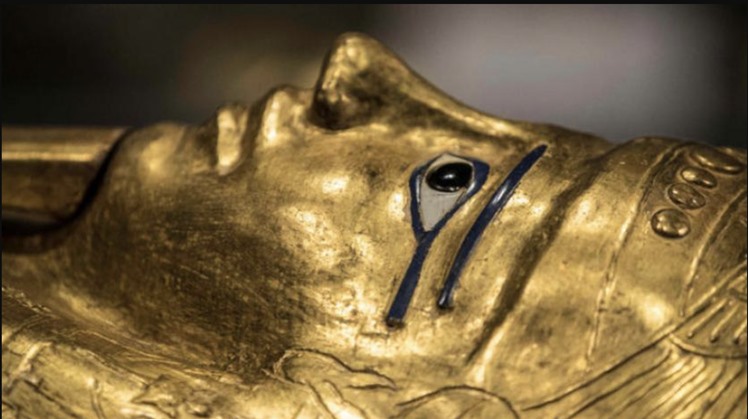
The mummy-shaped sarcophagus is 6 feet (2 meters) tall and skillfully made of wood and metal, and is covered with gold plates, elaborately decorated with scenes and hieroglyphic texts intended to guide the priest on his journey to eternal life, according to CNN reports. The gold in the coffin indicates the priest's special relationship with the Egyptian gods, as it was widely believed that the gods were made of the precious metal.
As for the place where the sarcophagus of "Najm Ankh" was displayed, it is among the exhibits of the National Museum of Egyptian Civilization, which was opened after receiving 22 kings and queens in a solemn procession, which dazzled the whole world. and took many souvenir photos with him.
 Tue, Mar. 29, 2022