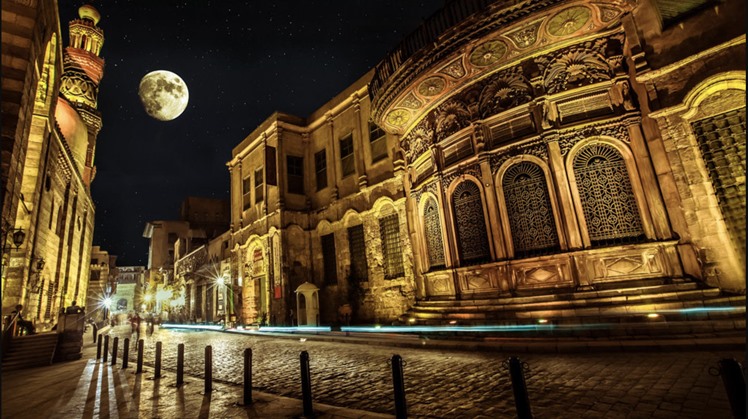
In the Al-Azhar area within the central Cairo district, the largest open museum of Islamic antiquities in the world is located, which is Al-Moez Street, which includes a group of antiquities since the establishment of Fatimid Cairo. On this day in 2008.
In Egypt, Al-Moez Street was established, where the city’s planning was crossed by a main street extending from Bab Zuweila in the south to Bab Al-Futuh in the north parallel to the Gulf.
Al-Muizz Street includes a constellation of the most beautiful Islamic monuments in the world, amounting to 29 monuments, including mosques, schools, cemeteries, bimaristans, fountains, kottayeb, palaces, two agencies, three corners, two gates, and two bathrooms. Bab Zuweila, Al-Aqmar Mosque, Sultan Al-Moayad Mosque, Qalawun Mosque, Al-Hakim Mosque by the Command of God, Mosque and Sabil Suleiman Al-Agha Al-Silhadar, Sultan Barquq Mosque, Muhammad Ali’s Sabil, Sabil and Kitab Abd Al-Rahman Katkhuda, Sabil and Kitab Khusraw Pasha, Sultan Al-Ghouri Collection, and the Prince’s Palace Bashtak.
The Ministry of Tourism and Antiquities had recently completed the work of the first phase of the project of the Ministry of Tourism and Antiquities to develop and raise the efficiency of lighting Al-Mu’izz Lidin Allah Al-Fatimi Street in Al-Gamaliya District, within the framework of the Ministry’s plan to develop and raise the efficiency of a number of archaeological areas throughout the Republic, including street lighting and internal paths. Through the use of some types of side lighting, taking into account the preservation of the historical and archaeological identity of the street. The works also include the implementation of qualitative and directed lighting on the facades of archaeological buildings with a distinctive urban character to highlight the extent of the beauty of the architectural formation of monuments and decorations overlooking the street.
 Wed, Feb. 23, 2022