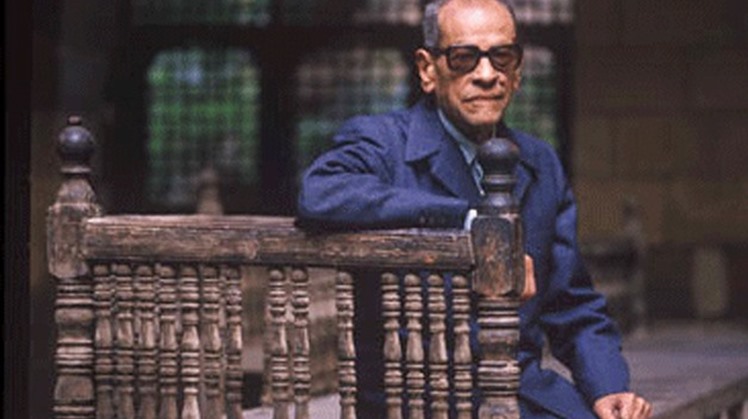
In “Darb Koramuz” or “Haret Koramuz” as it is called, precisely on the corner of that very narrow lane, meters away from the Al-Gamaliya Police Station, was the property No. 7 located in the path. And literature, Khaled became the male and the biography, and one of the most important Arab writers in the twentieth century, and the only Arab to win the Nobel Prize in literature, he is the international writer Naguib Mahfouz.
The Nobel writer passed away 15 years ago, on August 30, 2006, after placing the Arabic novel in the ranks of the world, and he was able to immortalize his name in the sky of world literature, and become the only Arab writer to win the Nobel Prize in Literature, and since then no other Arab has won the award.
Naguib Mahfouz Abdel Aziz Ibrahim Ahmed Al-Basha was born in Al-Gamaliya district in Cairo on December 11, 1911 AD, to an employee father and a housewife mother. He graduated from the Faculty of Arts at Cairo University, Department of Philosophy. in literary research; He chose to devote himself to literature, so his novelist works were a philosophical trick.
Mahfouz began his journey in the world of literature from the short story portal, and published his first stories in Al-Resala magazine in 1936, and his first novel was “The Abatement of Destinies” published in 1939. Triple Historic View.
From history to realism, Naguib Mahfouz’s literature shifted, as the focus began on realistic literature in 1945 AD with the novels: “New Cairo”, “Khan Al-Khalili” and “Al-Madaq Alley”, then he resorted to symbolic novels as in his novels: “The Beggar” and “The Rest of the World.” The time is an hour,” and “The Children of Our Neighborhood,” and the latter was the cause of a long controversy that led to an attempt to assassinate him because of religious interpretations of the novel that did not like the conservatives, so that it was prevented from publishing for a long time.
The novelist and writer "Naguib Mahfouz" has transformed during his long literary journey in monitoring life in general, the features of life inside Cairo in particular; To turn himself into a fixed feature in the history of the Arab novel and the history of modern Egypt; Thus, Mahfouz moved through that long journey of stories and novels of a pharaonic and historical nature, observing fates, the paradoxes of life, its absurdity and its vague ambiguity, in a way that is closer to philosophical and contemplative questions in a narrative form; As in: Ancient Egypt (1932) Whisper of Madness (1938) The Absurdity of Destiny Radopis (1943) The Struggle of Thebes (1944).
After that, "Mahfouz" moved to the history of the novelist, and dyed his long novels with neo-realism, which is one of the most beautiful stages of Mahfouz; Where he will be creative in drawing his characters within complex social patterns and magical realism, the flame of hope lights up for its characters and readers, and then extinguishes in the face of the severe and tragic winds of reality, like lightning lights up and disappears; The eyes deviated and the minds confused, and in general, Naguib Mahfouz's literary works came as a masterpiece of fiction that can be interpreted philosophically, so he appeared as a philosopher who lost philosophy and gained the Arab novel, as described by critics.
Naguib Mahfouz received many awards and honors, the most important of which is that he won the International Nobel Prize in Literature in 1988. His works have been translated into almost all languages and are taught in different universities around the world. With the passage of time, his works became like gold. More we found a rare writer and philosopher, permanent biography, who showed eternity.
 Tue, Aug. 31, 2021