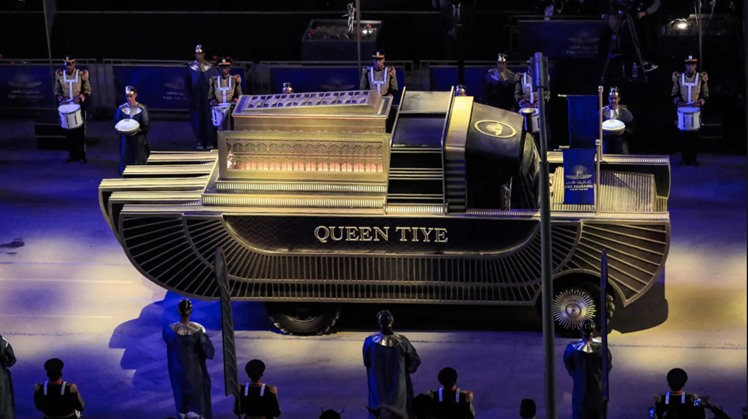
The National Museum of Egyptian Civilization is preparing to open the Royal Mummies Hall, today, at nine o'clock in the morning, which was transferred from the Egyptian Museum in Tahrir, in a majestic procession praised by the whole world, which included 22 mummies of the ancient kings of Egypt, in a way that confirmed the greatness and nobility of Egyptian civilization Ancient, and most of the mummies were previously shown, but there are 5 mummies that the public sees for the first time, and this is what we review during the next report.
Queen Ahmose Nefertari
She is the daughter of King Seknen Ra Taa, who led the war against the Hyksos. She married her brother, King Ahmose, the first king of the 18th family and the modern state, and they had many children, among them King Amenhotep the First, who succeeded his father on the throne of Egypt. Queen Ahmose Nefertari was queen. Strong and influential during her life, she was sanctified with her son Amenhotep the First in the village of Deir el-Medina «the village of workers of the tombs of the kings in the Valley of the Kings» west of Luxor after her death.
The queen's mummy was found in a huge wooden and cartonnage coffin in the Deir el-Bahari cache, west of Luxor, where her arms are clearly visible, crossed on the chest, and bears the hieroglyphic Ankh sign, which means life.
King Amenhotep III
He is the son of King Tuthmosis the Fourth, from the eighteenth dynasty, the era of the modern state, Amenhotep the Third ascended the throne as a young man, and ruled for a period of between thirty-seven or thirty-eight years, his reign represented the height of Egypt's power, wealth and glory, Queen Tee was his great royal wife.
His funerary temple is preceded by huge statues, now known as the Colossi of Memnon, and among the king’s magnificent statues is the huge statue of King Amenhotep the Third and his wife T, who are sitting in stability - a symbol of their eternal power - and it is located in the Egyptian Museum in Cairo. On the king's mummy in 1898 in the tomb of Amenhotep II «KV 35» in the Valley of the Kings in Luxor.
King City II
He is the son of Merneptah and East Nefert the second, the nineteenth dynasty, the era of the modern state, the rule of Seti II, the fifth king of the nineteenth dynasty, for nearly six years, and although the reign of King Seti II was short and turbulent, he left behind many important traces of Among them is a cemetery for himself in the Valley of the Kings «KV 15», but it was not completed at the time of his death.
The king's mummy was found in 1898 in the tomb of Amenhotep II «KV 35» in the Valley of the Kings in Luxor. The features of the face of King Seti II were well preserved, and small faience amulets were found on chains wrapped around the lower part of the mummy.
King Siptah
He is from the nineteenth dynasty, the era of the modern state. King Siptah came to the throne while he was a boy, at the hands of a powerful senior statesman named “Bay”. Because of his young age, his father’s wife, Tausert, wife of King Siti II, became the regent of the throne.
The king's mummy was found in 1898 in the tomb of Amenhotep II “KV 35” in the Valley of the Kings in Luxor, wrapped with many layers of linen, and some resin-impregnated wraps, and it seems that he died very young before the age of twenty.
King Ramses VI
He is one of the sons of King Ramses III, who ruled for eight years, in his capacity as a royal son, and the king's mummy was found in 1898 in the tomb of Amenhotep II KV 35 in the Valley of the Kings in Luxor, and it seems that the king died in middle age, the cemetery layout was simple, as it consists of a group of The descending corridors in a straight line lead to the burial chamber in the deep underground, and its inscriptions are in a good state of preservation, but it is clear that the level of inscriptions is lower than the Nineteenth Dynasty (about 1295-1186 BC). The scenes of the cemetery contain many funerary inscriptions that help the king to move peacefully to the afterlife.
 Sun, Apr. 18, 2021